The PlanToys Victorian Dollhouse: Why Empty Rooms Are Full of Learning
Posted on 2026-08-27 by Jane Smith
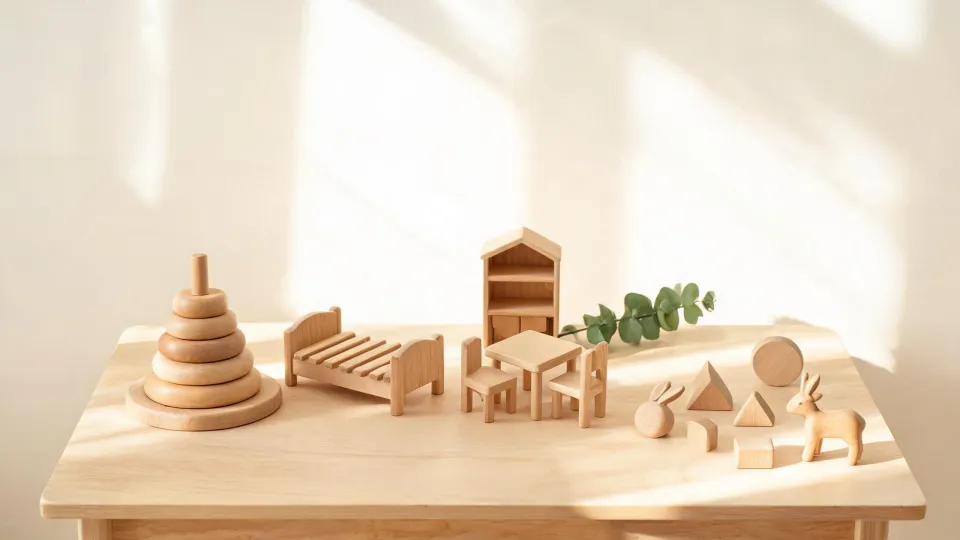
Picture a four-year-old standing in front of a wooden house that is barely taller than her knee. She has just discovered that the front door really swings open — not with a plastic click or a pre-recorded chime, but on a tiny wooden hinge that moves under her finger. She opens it, peeks inside, closes it, and opens it again. From the sofa, you watch the fifth open-and-close cycle and wonder if this is going to be another toy that loses its charm before dinner. That question — will she tire of it? — is the one every parent asks, and the answer has less to do with the toy than with the space it leaves for the child to fill.
A Door That Opens a Question
You’ve just lifted the PlanToys Grand Victorian Dollhouse out of its box, and the first thing you notice is the weight of the wood — dense, smooth, and reassuringly real. The brand’s own website lists this model among its featured sets, alongside recognition like Japan’s Good Toy Award and Germany’s Spiel Gut recommendation. Those awards come from institutions that test toys over years, and they matter because they signal a design built for endurance. The same page describes the dollhouse as a place where children can play creatively inside a dream house designed by their own imagination. That phrase becomes meaningful when you see the physical object: every window is a real opening, every staircase has actual steps, and the rooms are furnished but not overcrowded. There are no buttons, no lights, no hidden speakers. Your four-year-old is already trying to make a tiny teacup fit in a doll’s hand. The toy is designed to be a blank stage for her story, and that blankness is the point.
The door clicks shut for the tenth time, and your daughter turns to you with a look that mixes curiosity and suspicion: 'What do we do now?' If you are used to toys that perform — a learning tablet that asks questions, a kitchen set that sizzles with pre-recorded sounds — the silence of this wooden house can feel like an absence, even a defect. The familiar worry surfaces almost immediately: won’t a child get bored of a house that does not do anything? Is this an expensive piece of furniture dressed up as a toy? It is a legitimate concern, and it is also the precise misconception this guide exists to address. The mental model behind it is simple: toys are supposed to supply activity, and the more activity they supply, the better the toy. Under that model, an empty wooden house is a failed product. But watch what happens over the next ten minutes. Your daughter stops asking you what to do and starts asking herself. She moves a chair from the dining room to the bedroom because the grandma needs to sit down. The toy is not performing, but the child is. That reversal — from passive observer to author of the scene — is the shift this field guide wants to make visible, and it begins the moment you allow the question to remain unanswered for a beat too long.
The 'Just a Dollhouse' Fallacy
Nobody says it out loud, but a lot of parents carry the same assumption: a toy that doesn’t light up, move, or make noise is a passive toy. The Victorian dollhouse, with its precise little rooms and miniature furniture, looks more like a collector’s item than a plaything. It seems to belong on a shelf, not on the floor where feet can kick it. If a child does play with it, the worry goes, she will simply arrange the furniture once or twice and then abandon it for something with more immediate rewards. This reading is tempting because it matches our experience of cheap plastic toys that shout for attention and then become invisible. But it misreads what a house is for in a child’s world. A house is not a game; it is a stage. The misconception is reinforced by the fact that the dollhouse is often marketed as a collector’s item, which makes it seem delicate and precious. Yet children do not need precious objects; they need usable ones. The moment you see a child lift the entire house to turn it upside down and make the roof a boat, you realize that the harshest critics of open-ended toys are usually adults, not children.
PlanToys has spent nearly four decades designing toys around a clearly stated priority: child development. Its materials and manufacturing are built around what the company calls a 'Sustainable Way,' but the more relevant part for parents is the explicit claim that design decisions begin with 'child safety and age milestones.' That is why the dollhouse has no sharp edges, why the wood is smooth, and why the colors are gentle. It is also why the structure is simple enough for a preschooler to rearrange on her own. The absence of automatic features is not an oversight; it is a deliberate engineering choice. A toy that does nothing leaves room for a child to do the acting, the narrating, and the deciding — which is precisely the kind of work that builds executive function and language. The evidence for this is not a single study but the consistent logic of the brand’s own product philosophy. This matters for your decision: when you buy a dollhouse that is intentionally incomplete, you are not buying an object with a missing function; you are buying a scaffold for functions the child will invent herself. The proof is in the brand’s longevity — a company that has stuck with this philosophy for four decades is not producing toys by accident, but by conviction.
Why the Empty Rooms Fill With Thinking
To see what the empty room actually does, you need to watch a child who has crossed the threshold of that first awkward minute. The catalogue’s line about a dream house designed by each child’s imagination stops sounding like marketing once you observe the mechanism firsthand. Once your child stops waiting for the toy to give her an instruction, she begins supplying her own. She picks up the little mother, walks her up the stairs, and starts inventing a reason for her to be there. Maybe she is tired. Maybe she has lost a key. Maybe she is waiting for the father to come home from work. None of this is written anywhere on the box; it is generated by the child, in real time, from the raw material of her own family life. The mechanism is simple: the more a toy leaves unspecified, the more the child must specify. That is the causal chain that links open-ended materials to narrative thinking.
The effects ripple outward quickly. The first is language: a child who narrates her dollhouse scenes is practicing vocabulary, syntax, and storytelling in a low-stakes setting. You will hear her re-enact a doctor’s visit, a birthday party, or a quarrel between siblings, using words she picked up from real life and testing new ones. The second effect is fine motor control: opening tiny latches, positioning miniature chairs, and lifting small figures are precise movements that strengthen the small muscles of the hand. The third effect is social: when two children play with the same house, they must negotiate who occupies which room, what time of day it is, and who gets to be the baby. Those negotiations are early lessons in perspective-taking and compromise, and they happen because the toy does not impose a script that would settle the argument in advance. None of this depends on batteries, and none of it can be delivered by a toy that already has the story written.
Understanding this mechanism makes the brand’s larger story easier to trust. PlanToys was founded in 1981 by seven university graduates who wanted to 'infuse the world with positivity,' and the company has stayed in the same family of values ever since. Its manufacturing process turns leftover sawdust into a new material called PlanWood, an example of what the company calls its 'Sustainable Way.' These details matter for parents because they translate into concrete safety and durability promises: the wood is sealed with non-toxic finishes, the pieces are made to survive years of play, and the company openly says that child development is its focus. When a toy company makes a philosophical commitment to environmental and developmental goals, it tends to carry those commitments into the details — the thickness of a wall, the smoothness of a hinge. That is not a guarantee that every child will love every product, but it raises the odds that the toy will earn its place on the floor rather than the shelf.
Choosing the Scene: A Practitioner's Checklist
So how do you choose well, and how do you introduce a wooden dollhouse without watching it become a dusty display? Start with the toy itself. Look for a dollhouse that uses smooth, solid wood and non-toxic finishes; PlanToys’ own website highlights products organized by 'developmental domains,' a reminder that the best toys are designed with specific skills in mind. Check the size of the openings: furniture and figures should be large enough for small hands to grip comfortably, but not so chunky that there is no room for detailed manipulation. Consider how many rooms there are and whether the pieces are open to rearrangement. A house with fixed, over-decorated interiors may look impressive but leaves less space for invention. Also pay attention to the brand’s history as a signal of durability: PlanToys still sells its original Geometric Sorting Board, a product that has stayed in continuous production since the company’s founding year. A toy that stays in production for decades is one that children keep coming back to.
Once the house is home, the adult’s job is to provide a gentle scaffold without taking over. The most common mistake is leaving a child with a new open-ended toy and expecting instant invention. Instead, spend the first ten minutes playing alongside her and showing, through your actions, that the rooms can be rearranged, that the figure can walk up the stairs, that a block can stand in for a table. Narrate a simple action — 'I think the grandma is going to make tea' — and then go silent, letting your child take the lead. If she freezes, ask an open question: 'What do you think the family is doing upstairs?' Avoid the urge to turn play into a quiz; the goal is to model possibility, not to reward correct answers. Also keep a small basket of extra items nearby — a spare piece of fabric for a blanket, a paper towel tube for a slide — so that the dollhouse can become a building toy as well as a dollhouse. That flexibility is what carries it past the first few weeks.
When the Little Door Swings Shut (and Open Again)
Several months later, the scene looks different. The dollhouse has migrated to the corner of the living room, and on a Thursday afternoon your daughter is on her knees beside it with a neighbor’s child. They have been arguing — politely, with pauses — about which room is the 'hospital' and which is the 'house' for the baby. The front door you once watched her open five times in a row is now standing wide open, with a small plastic animal standing in the doorway. The furniture has been rearranged so many times that the dining room chairs live in the bathroom. She has forgotten that the toy is supposed to have limits, and that is exactly what you hoped for. The house has not become boring; it has become a place where boredom would be out of place.
This is why the rule that follows is so useful, and it comes from PlanToys’ own framing of its mission: 'Better Kids, Better World through Sustainable Play.' The rule is simple: before you buy any toy, ask how many of the ideas are supplied by the toy versus how many will have to be supplied by the child. A toy that leaves more room for the child’s own invention is rarely a waste of money. The PlanToys Victorian Dollhouse is an extreme example of that principle — a house with empty rooms, silent doors, and a design that has earned awards for quality — but the principle transfers to building blocks, dress-up clothes, and even cardboard boxes. When the little door swings shut, the story does not end; the child opens it again and decides that the family inside has moved, or bought a dog, or gone to the moon. That opening you are buying is a permission to imagine, and it will not close with age.
And when that little door swings shut for the hundredth time, you will know the story is not over — it is simply waiting for the child to decide what happens next. Choose the toy that leaves that door open, and you have given her a world she can keep rewriting.

Jane Smith
I’m Jane Smith, a senior content writer with over 15 years of experience in the packaging and printing industry. I specialize in writing about the latest trends, technologies, and best practices in packaging design, sustainability, and printing techniques. My goal is to help businesses understand complex printing processes and design solutions that enhance both product packaging and brand visibility.