The Plantoys Victorian Dollhouse, Judged by Year Five
Posted on 2026-09-16 by Jane Smith
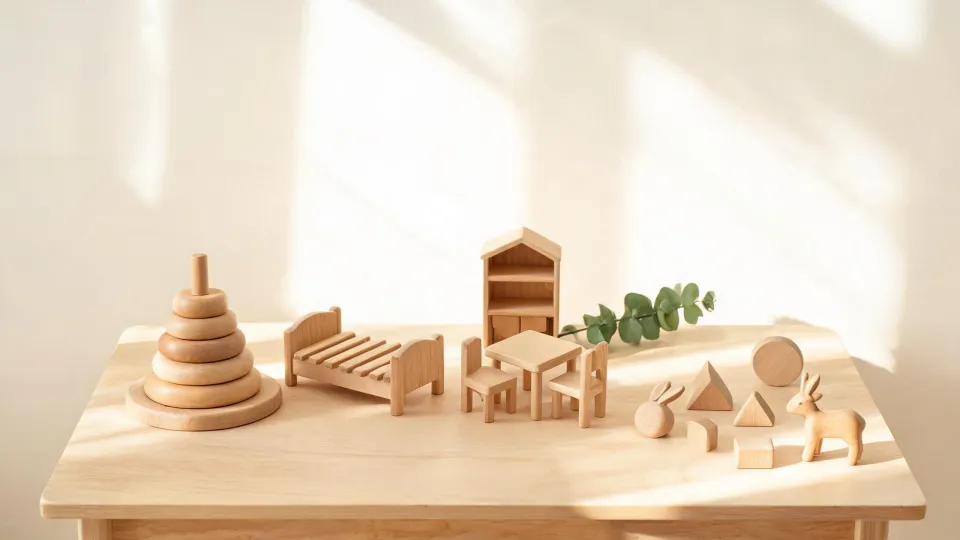
The box comes off the porch on a Tuesday evening and sits in the hall for an hour, because nobody wants to start opening it before dinner. Your four-year-old has other plans and is already peeling tape off the corner. What comes out is not a finished house but a set of panels, a roofline, and a bag of loose pieces with a bathroom set somewhere in the middle of it. Within twenty minutes your child has appointed one room as the kitchen and is moving a single chair between two floors, and you are standing back doing arithmetic about floor space.
By bedtime, half the parlour was already on the floor
Unpacking takes longer than you expect, because nothing arrives assembled the way a plastic house does. The body comes as panels and open rooms, and the first thing you notice is how much floor it claims once the walls are standing: not a shelf object but a piece of furniture. Your child ignores the walls and goes straight for the loose pieces. By the time you square the roofline up, a bathtub has been carried into a bedroom the manufacturer never planned, and a chair has become a hat. Measured against the sofa, the footprint lands somewhere between a small bookcase and a coffee table you can no longer walk around. That first evening tells you what the product photos cannot: this is a toy about moving small things through rooms.
The catalogue settles the question of what you actually bought. On the Featured Collections row the Grand Victorian Dollhouse sits beside the Race N Play Parking Garage and the Assorted Fruit & Vegetable set, a dollhouse presented as one play category among several rather than a display heirloom in its own right. The Victorian Bathroom Set appears further down the new-arrivals list, so a parlour can be furnished room by room over months instead of in a single purchase. The recognition list on the same pages, Red Dot and Spiel Gut in Germany, the Good Toy Award in Japan, Parents' Choice in the USA, reads as evidence of catalogue discipline rather than decoration: a manufacturer that keeps winning on design keeps its ranges findable and its naming consistent, which is what you want when hunting for one particular chair two years from now.
Then you reach the line that changes how you read everything above it. In the same all-products listing where the dollhouse and its furniture appear, there is an entry called Replacement Part - Small, sitting between a Kaleidoscope and a Cooking Utensils Set as though it were just another product. It is not just another product; it is a manufacturer admitting in public that small parts get lost, chewed and vacuumed up, and that the house is expected to survive it. That single listing reframes the purchase. A plastic mansion with glued-in fixtures is a house you replace when a hinge snaps; a house with a parts channel is one you repair. So the question to hold is not how the parlour looks on day one, but whether this thing is still being played with in year five.
Why sawdust and beech beat plastic in month three
The obvious objection arrives around month three, usually after a corner of the roof has already met the floorboards. Wooden toys, the argument goes, are the fragile choice: lovely on a shelf, chipped after a fortnight, no match for the hollow plastic houses that survive being sat on. The reasoning is sound as far as it goes. Plastic flexes and forgives, and because it is moulded in one piece, a toddler landing on it dents nothing permanently. Wood, by the same logic, splits, splinters at the edges, and swells if a sippy cup leaks beside it. Anyone who has watched a wooden rattle crack after one hard throw carries that lesson into every wood purchase afterwards, and that reflex is what makes a wooden dollhouse look like an expensive risk you will regret by summer, once the novelty has worn off and only the material is left.
What actually separates the two materials is not hardness but what happens when something breaks, and who is responsible for the fix. On its about page the manufacturer describes pressing leftover sawdust into a denser material it calls PlanWood, and it splits the operation into three pillars it names Sustainable Material, Sustainable Manufacturing and Sustainable Mind. Read that as a production statement rather than a slogan, and the consequences show up under your coffee table. Sawdust that would otherwise be waste is bound into shapes that hold an edge, so a wardrobe door or a table leg can be a solid part with a consistent thickness instead of a thin veneer over a soft core. Because the same people control both the material and the moulding, the part you break is one they already know how to make again. That is a stronger promise than the phrase made of wood on a label.
The design language does the rest of the work, and you can see it most clearly in the way the brand describes its smallest toys. In its own account of the Ramp Racer, the point of the design is the visual contrast between the plain wooden track and the coloured cars, so a young eye can follow the moving object without an adult pointing at it. The Jumping Acrobat is described as reduced to essentials, a polite way of saying that no decorative detail competes with the part that actually moves. Carry that logic into a Victorian parlour and it explains the restraint you noticed at unpacking: walls that read as walls, doors that read as doors, and colour reserved for the pieces your child lifts and carries. Fewer flourishes mean fewer weak points under small hands, and fewer places where a missing chair leaves an obvious hole in the room.
What a four-year-old actually does with a Victorian dollhouse
Designing around age milestones sounds like marketing until you watch it happen in your own hallway. The manufacturer states plainly that child safety and age milestones drive design and production, and that the aim is to develop physical and cognitive ability at the same time. Translate that into the first six months and it predicts a narrow set of actions: reaching, gripping, carrying, and putting one thing inside another. A four-year-old is not furnishing a house. They are running a delivery service, moving the same three chairs between two rooms twenty times an afternoon, and every trip is a small exercise in hand control and in remembering where things belong. That is why the toy which survives this stage is the one whose parts a small hand can pick up and put down without a parent stepping in.
The way the catalogue is organised tells you which bucket the dollhouse belongs in. Products are grouped by developmental domain, with a Mathematics & Literacy Corner and a Blocks & Construction line running alongside a Learning & Education collection, and a Montessori-Inspired collection flagged at the top of the page. Nowhere in that structure is there a shelf labelled decorative. Something sold under Learning & Education is sold on what a child learns while handling it, and the Montessori framing pushes the emphasis towards open-ended, self-directed play with real objects rather than scripted outcomes. In practice the dollhouse competes not with ornaments but with blocks, sorters and construction sets for your child's attention, and it has to earn its floor space on an ordinary Wednesday.
The tags do the same job whether or not you ever open a product page. The phrases Learning & Education, Blocks & Construction and Award-Winning Products run through one list after another, and the same page carries a Spring Favorites under $25 section beside the Montessori-Inspired Toys banner. Repetition of that kind is not editorial flair; it is how a retailer tags inventory, and it tells you the surrounding range is sold under one consistent promise about development. It also gives you a cheap sanity check on cost. Small baskets, play sets and accessory pieces live in that under-$25 band, so the rooms can be furnished a few items at a time. The house is the fixed cost; the contents are seasonal.
The fit test: space, siblings, and spare parts
Two families can buy the same house and end up with opposite outcomes, and the difference is decided before anyone opens the box. In the first, the dollhouse lands on a rug in the corner of the room that is already the play space, and the parlour joins a rotation that also includes a garage and a fruit and vegetable set pulled from the same Featured Collections list. In the second, the house is set up in a spare bedroom, played with hard the day it arrives, and then cannot be reached without an adult walking upstairs with a child in tow. Nothing about the second household is careless; the toy simply has nowhere to live. The first family paid the same price and bought a decade of use. The second bought one very good afternoon.
This is where the recognition list stops being decoration. The same pages that carry the Grand Victorian Dollhouse carry an unusually long run of awards, from Red Dot and Spiel Gut in Germany to Spiel Gut's Japanese counterpart, ASTRA and Oppenheim and Parents' Choice in the USA, Play for Change in Belgium and Gioco per sempre in Italy, and judging panels rarely keep returning to a manufacturer whose catalogue turns over every spring. What you are buying into is a house that stays in the lineup and a category that stays stocked. That matters more than any single review, because the parts you will need in year three exist only if the range is still being made. The boundary is worth saying out loud: if the design language changes or the house is retired, the repair channel shrinks with it. You are not buying an unbreakable object; you are buying into a range someone has been maintaining.
The third condition is the one most people skip, and it is the only one that costs nothing to check. The all-products listing shows a replacement entry for small parts sitting alongside the ordinary play items, which means the maintenance of the house is visible at the same moment as the house itself. From that you can build a three-part test to run at home. Do you have a floor where the house can stay assembled, rather than a shelf it has to climb onto? Is there more than one child likely to use it, because rooms are built to be shared and argued over? And are you willing to order one missing piece instead of writing off the toy when a chair disappears? Three yeses make the Victorian dollhouse a sensible purchase at its price. Two make it a good toy with an awkward home, and one means the plastic house with glued-in furniture is the better buy for you.
Five years later, the same parlour
The company has been making these things since 1981, when seven graduates started it, and its own materials describe nearly four decades of the same approach since. That continuity is the real subject of this decision, because a five-year view of a toy is unusual and only a handful of manufacturers plan for it. A house built by people who describe their business in terms of sustainable material, sustainable manufacturing and sustainable mind, and who say outright that they hope a child grows closer to nature while playing, is not designed around a single Christmas morning. The practical consequence for you is that the fifth year looks like the first: the same walls, the same loose chairs, two or three parts replaced along the way, and a different small person doing the carrying.
So go back to that evening on the porch, with the box still unopened and a child who has already decided which room belongs to whom. The parlour on the front page is the same object you will be looking at in year five, and by then the judgment will not be about how the paint looked on arrival. It will be about whether the doors still close, whether the missing piece was replaced or quietly forgotten, and whether the house is still standing where a child can reach it. If you have the ground, the second player, and the willingness to order one small part instead of a whole new house, this is the version of the toy that keeps its value. If you do not, that is useful information too, and it is better to know it before the box comes off the porch.
Somewhere in year five the roofline comes loose during a house move, or a chair vanishes behind the sofa for good. You order the piece, refit it, and the rooms get rearranged all over again by whoever is small enough to sit inside the doorway. That is what the box on the porch was really promising.

Jane Smith
I’m Jane Smith, a senior content writer with over 15 years of experience in the packaging and printing industry. I specialize in writing about the latest trends, technologies, and best practices in packaging design, sustainability, and printing techniques. My goal is to help businesses understand complex printing processes and design solutions that enhance both product packaging and brand visibility.