The Dollhouse That Grows With Your Child: A PlanToys Victorian Field Guide
Posted on 2026-08-25 by Jane Smith
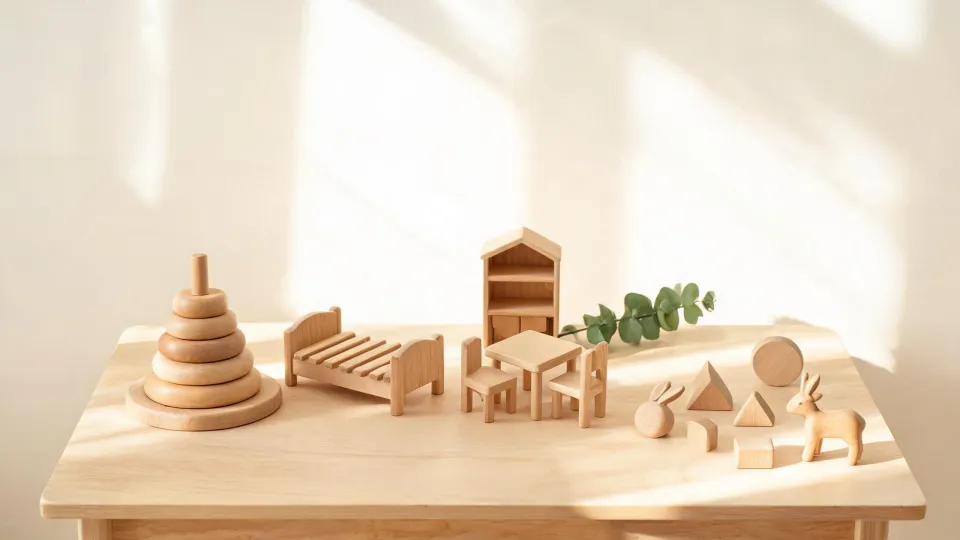
On a rainy Saturday, a large box lands on the dining table. You slice through the tape and lift out a pale wood dollhouse—three stories of smooth rubberwood, tiny turned balusters, and a sloped roof that catches the light. Your child, just four, presses a hand flat against a wall and asks, 'Is it real?' That question, half wonder and half doubt, is the reason this guide exists.
The Moment the Rooms Came Alive
Inside, the furniture waits in nested bags: a miniature sofa with a worn-looking cushion, a table with four tiny chairs, a bed with a turned-post frame. The pieces are heavy for their size, and the surfaces are silky—no sharp edges, no painted smell. You set the house on the rug, and your daughter immediately kneels, peering through the front opening. She picks up a chair and turns it over, studying the simple peg joint. Then she places it in the parlor, steps back, and frowns because it isn't straight. That small adjustment—the first of many—is where play begins.
Many parents' first instinct is that a Victorian-style dollhouse is a display piece, not a plaything. The delicate balusters, the high-pitched roof, the faded-pastel palette—all of it whispers 'look, don't touch.' PlanToys, however, markets this piece as something else. Their official site describes the Grand Victorian Dollhouse as part of a sustainable wooden toy collection explicitly designed for child development. From the same catalog that lists a Montessori-inspired collection and sections for 'Blocks & Construction' and 'Learning & Education,' the dollhouse appears not as a decorative replica but as an open-ended play environment. The challenge for a parent is to see past the ornament and toward the child-size stories waiting inside.
Once the house is assembled, the real question surfaces: will a four-year-old actually play with it, or will it become a very expensive shelf ornament? The answer depends less on the child's age than on the adult's expectations. A dollhouse that arrives pre-furnished and perfect often gets abandoned after the first day. A house that asks for rearrangement, that leaves room for a family to move in and a plot to unfold, tends to be pulled out again and again. So before you judge the toy, you have to test how it behaves on a living-room floor.
The Wood Beneath the Paint
Parents often say wooden toys are heavy, hard, and prone to splinters—unsafe for a toddler who still mouths everything. Plastic, the argument goes, is light and forgiving. That assumption ignores how modern rubberwood toys are engineered. The pieces are sanded to a silky finish, and the joints are tight enough that a child can't easily pull them apart. You still wouldn't hand the tiny chair to a one-year-old, but for a child past the mouthing stage, the heft is actually a plus: it gives the dollhouse stability when small hands rearrange rooms.
PlanToys takes sustainability seriously enough that they developed a material called PlanWood, made from leftover sawdust that would otherwise be discarded. The company describes this as part of a 'Sustainable Way'—a commitment that runs through their material selection, manufacturing processes, and business mindset. The result is a dense, smooth composite that holds detail well and resists moisture better than raw wood. For a toy that will be carried from room to room, dropped on hardwood floors, and occasionally wiped clean, that durability matters. It also means no plastic-derived gloss or paint flaking into little mouths. The green business practices behind PlanWood aren't a marketing afterthought; they're the reason the dollhouse can be both safe for daily use and sturdy enough to become a hand-me-down.
That focus on quality is rooted in the company's founding. In 1981, seven university graduates came together with a shared mission 'of infusing the world with positivity,' and Vitool Viraponsavan went on to establish PlanToys. From the start, the company positioned itself as more than a manufacturer; its stated priority is 'child development is our focus.' That lineage explains why the dollhouse doesn't feel like a piece of decorative furniture. Every angle, joint, and surface was chosen with a child's physical and cognitive milestones in mind. When a toy maker has spent nearly four decades refining that balance, the higher price tag starts to look like an investment in engineering, not just aesthetics.
The Day the Stories Started
The other common worry is that a single dollhouse will bore a child within a week. 'She'll set it up once and never touch it again,' a parent might think. That prediction usually holds for toys that are static—a house with every room already perfect, a dollhouse with predetermined furniture placements. But the Victorian Dollhouse from PlanToys is deliberately open. The rooms come with just a few pieces of furniture, and nothing is fixed in place. A child can rearrange the parlor, turn the upstairs bedroom into a kitchen, or block off a doorway to see what happens. The emptiness isn't a flaw; it's an invitation. Because the layout changes with every session, the toy doesn't become a fixed object that loses its novelty.
The design philosophy behind this openness aligns with Montessori-inspired principles, which PlanToys highlights throughout its catalog. Rather than prescribing one correct way to play, the dollhouse provides a neutral structure that a child can populate with her own rules. On the company's website, the same collection that includes the Grand Victorian Dollhouse also lists PlanSpace Modular Dollhouse, described as 'stackable fun, endless creations—your dream space awaits.' That language points to a deeper truth: the toy's value lies in its adaptability, not in realistic detailing. International recognition backs this approach. PlanToys has received awards like the Red Dot Design Award and the Oppenheim Toy Portfolio Gold Seal, which are given for design quality as much as for play value. The dollhouse isn't a miniature mansion to be admired; it's a framework for the child's own architecture.
That kind of self-directed play has measurable benefits. When a child scripts a family's morning routine with the dollhouse, she is practicing sequencing, negotiation, and language. When she rearranges the furniture to make a bedroom for a new baby, she is exercising empathy and problem-solving. PlanToys' stated mission, 'child development is our focus,' isn't just a slogan; it's embedded in how the rooms are sized and how the furniture fits together. The slightly oversized doorway and the sturdy chair that won't topple when a small hand reaches for it are the result of decades of observing how children actually move. The result is a toy that grows with the child: a two-year-old uses the house for sorting and stacking, while a five-year-old turns it into a narrative world.
When the Bathroom Set Arrived
Three weeks after the unboxing, the dollhouse has acquired tenants. A small bear sits at the dining table, a car is parked in the parlor, and the bathtub has been repurposed as a swimming pool. Your child narrates as she moves figures: 'Mama bear is going to work now. Baby bear is crying because he wants a cookie.' She moves a chair from the bedroom to the kitchen, announcing that the family is eating breakfast together. There is no adult script here; the story comes entirely from her. What began as furniture placement has become a series of small scenes, each with its own logic. The house is no longer a toy; it's a stage where she rehearses the patterns of daily life she sees in her own family. That rehearsal matters more than the miniature decor.
To keep those stories fresh, PlanToys offers a range of companion pieces that plug into the same open-ended system. The Victorian Bathroom Set adds a claw-foot tub and a mirrored cabinet; the Living Room set brings a sofa and a bookshelf. These aren't required purchases, but they extend the narrative vocabulary. The brand's product catalog also pairs this Victorian model with PlanSpace modular modules, which promise 'endless creations.' Adding a room or a set changes the play geometry, forcing the child to reconsider her mental map of the house. A bathroom on the second floor can turn the whole upstairs into a spa, while a new cabinet in the parlor might invite a storefront scenario. With each addition, the dollhouse becomes a larger world.
The modular approach also extends the toy's lifespan. Instead of being a finished product that exhausts its possibilities in a month, the dollhouse is built for accretion. Because the pieces are compatible across sets, a child can combine the Victorian structure with a PlanSpace module to create a two-story addition or a separate pavilion. That flexibility means the toy doesn't have a fixed end state; it evolves as the child's interests evolve. When a child inevitably asks for something new, the answer isn't a different toy—it's a new room, a new set of characters, or a simple rearrangement. The dollhouse, in this way, becomes a long-term investment rather than a one-time purchase.
Six Months In, Still a Favorite
Months later, the dollhouse sits in a corner of the playroom, not on a display shelf. The roof has a small dent from a thrown block; the floor bears the faint scratches of a thousand tiny foot moves. A visitor once asked if you minded the wear. The wear is the point. The house has been lived in by imaginary families, used as a garage for toy cars, and once turned upside down as a pretend boat. It has survived the full creative assault of a four-year-old and emerged with only superficial marks. That durability, combined with the child's continued attention, is the real proof of value. When you think back to the early hesitation—the fear that the dollhouse would be a pretty but neglected object—you can see how wrong that prediction was. The toy hasn't been neglected; it has been absorbed into daily rituals. It gets moved, rearranged, and reimagined so often that it feels less like a product and more like a piece of the house itself.
On a cost-per-play basis, the PlanToys Victorian Dollhouse earns its price. The initial sticker shock fades when you calculate how many hours it has occupied the child's attention, how many stories it has hosted, and how many years it will likely serve a younger sibling. The company's reputation for sustainability and child development is not anecdotal; the recognition it has earned—Red Dot, Oppenheim, and Parents' Choice among them—reflects a consistent design philosophy—one that prioritizes child safety, openness, and durability over momentary trends. For a wooden toy that will be passed down, the difference between 'cheap and replaceable' and 'well-crafted and enduring' is exactly the difference between the plastic dollhouse and this one.
This evening, the dollhouse is quiet. The bear and the baby are asleep in the upstairs bedroom, the car is parked in the driveway, and the kitchen table is set for four. Your child closes a tiny door with the careful solemnity she reserves for rituals. She turns to you and says, 'Tomorrow they're going to the beach.' The house, once a question mark in a cardboard box, has become a place where her imagination lives. It hasn't been relegated to a shelf; it's part of her nightly routine. That's not the outcome you expected from a piece of wooden furniture. It's better. The dent in the roof, the worn floorboards, the slight give in the staircase where a small hand grips it—those marks are the signature of a toy that did its job. It was never meant to be admired. It was meant to be lived in, and it has been.
On the same rainy Saturday, six months later, your child doesn't ask if the dollhouse is real. She knows it's hers. She kneels beside it, opens the front, and begins to move the family through their morning. The rain taps the window; the house glows under the lamp. Somewhere in the furniture is the tiny chair she first straightened—still in place, as if it had never moved.

Jane Smith
I’m Jane Smith, a senior content writer with over 15 years of experience in the packaging and printing industry. I specialize in writing about the latest trends, technologies, and best practices in packaging design, sustainability, and printing techniques. My goal is to help businesses understand complex printing processes and design solutions that enhance both product packaging and brand visibility.