PlanToys My First Dollhouse: The Safer Wooden Start for Toddlers
Posted on 2026-09-04 by Jane Smith
-
A Straightforward Verdict: PlanToys for a First Dollhouse
-
The Material Safety Picture Behind PlanToys' Wooden Dollhouses
-
The Developmental Payoff of an Open-Ended Dollhouse
-
Matching the House Scale to a Toddler's First Play
-
Awards and History as Confidence for the Purchase
-
Final Verdict: The PlanToys My First Dollhouse and Its Boundaries
Yes for most families: the PlanToys My First Dollhouse is a top recommendation for a two-to-four-year-old, thanks to a non-toxic, sustainable wooden build, a development-focused design, and a reputation built over decades. It costs more than plastic playsets, but it gives a toddler a safe, open-ended stage for pretend play without the chemical gamble.
A Straightforward Verdict: PlanToys for a First Dollhouse
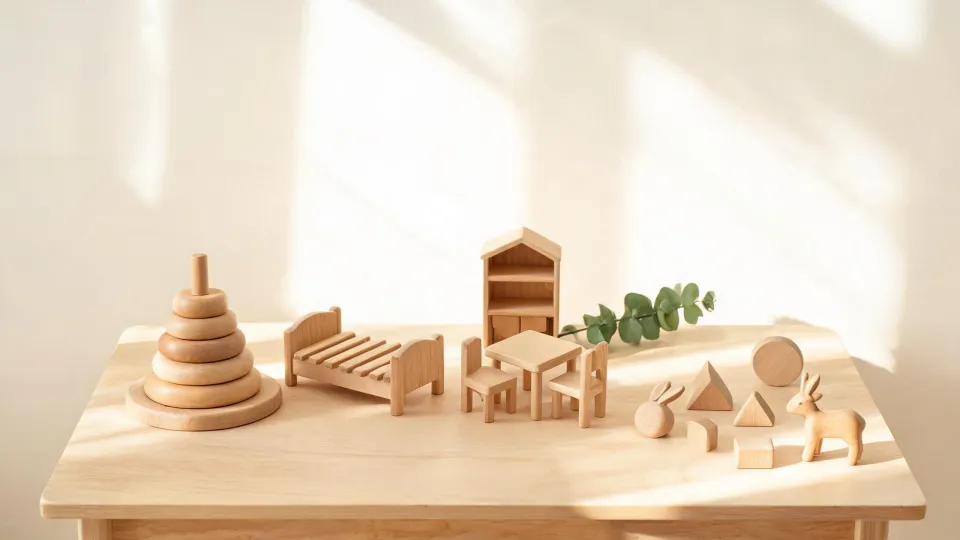
Between low-price plastic playsets and showpiece mansions sits the PlanToys My First Dollhouse, and for most parents of two-to-four-year-olds it is the better first purchase. The verdict rests on three evidence-backed pillars: a sustainable, non-toxic wooden build that answers chemical-safety worries, a design philosophy centered on child development, and a company reputation built over decades. The price does sit above the plastic dollhouses that crowd discount shelves, and the set looks plainer than a mansion stuffed with accessories, but that plainness is the point: a compact wooden house with honest materials gives a toddler a safe, open-ended stage for pretend play while sparing parents the gamble of unknown plastics and fragile parts. For most families, then, this is the sensible first purchase because it provides safety assurance without sacrificing the play value that keeps a child returning day after day.
The brand exists in this category, not around its edges. PlanToys' official homepage, run under the PlanToys USA name, calls the company a maker of sustainable wooden toys for child development, and the dollhouse line sits directly in that story: a PlanSpace Modular Dollhouse described as stackable fun with endless creations, plus a Grand Victorian Dollhouse listed alongside learning and education collections. Those pages also place the dollhouses near Montessori-inspired collections and developmental learning categories, which tells a parent that PlanToys treats the houses as learning tools rather than decorative furniture. A first-dollhouse recommendation therefore points to an active, currently sold product family rather than a niche or discontinued item.
From here the article moves through the questions that actually decide a purchase. First, is the material safe for a toddler who will mouth, drop, and climb on the house? Second, what does dollhouse play contribute to development? Third, which scale suits a first house, and which PlanToys styles fit that scale? The following sections answer each in order, correct one common assumption about where the toys are made, and close with a decision rule a parent can apply at the store. Readers who want only the buy or no-buy outcome can jump to the final section, while readers who need to justify the price will find the reasoning along the way.
The Material Safety Picture Behind PlanToys' Wooden Dollhouses
When a two-year-old picks up a dollhouse chair, the chair usually heads for the mouth before it reaches the miniature living room. That reality makes the purchase a materials question before it is a style question. Budget plastic sets are tempting because they arrive with many accessories for roughly the same money as one wooden house, but they ask parents to trust that every molded part and painted surface is safe for constant handling. A wooden first house shifts the question: fewer parts, natural surfaces, and finishes that should be non-toxic because a child will touch them daily. The practical test, therefore, is whether a specific brand can show a genuine non-toxic commitment — the exact standard PlanToys needs to meet.
PlanToys states that commitment in its own product language. Official pages describe the company as the non-toxic toy brand for peace of mind, and pair that promise with the phrase 'Play Safe, Play Smart with PlanToys.' For a parent comparing wooden houses with unlabeled plastic playsets, that is not decorative marketing; it is a brand-wide safety position placed directly on the page. The same material story continues in the from-trees-to-toys messaging, where every step of manufacturing is framed as a conscious sustainability practice rather than an afterthought. The implication for the purchase is concrete: when a dollhouse carries such positioning, the higher price buys a documented safety commitment instead of an unverifiable guess about cheap plastic compounds.
One detail regularly surprises parents who search for plantoys usa my first dollhouse: USA is the retail operation, not the factory. PlanToys states on its About page that products are sustainably made in Thailand, placing that fact beside nearly four decades of manufacturing practice. The same page explains that leftover sawdust is converted into PlanWood, a material that turns production waste into new play pieces. For the parent, Thailand changes the local-made assumption but does not weaken the safety story, because the brand's non-toxic and ecological claims are tied to its production process rather than any single country. It also reshapes expectations about shipping and support: a domestic site does not mean domestic manufacturing, and a family that insists on locally made toys should look elsewhere; a family that simply wants a responsible wooden house will find the Thai production aligned with the company's stated commitments.
The Developmental Payoff of an Open-Ended Dollhouse
Once safety is settled, the real value question appears: what does a toddler actually gain from dollhouse play? Between two and four years, a small house with open rooms becomes a training ground for fine motor control as small fingers place furniture, for language as a child explains who lives in which room, and for early social skills as dolls take turns and comfort one another. An open-ended setup supports those gains better than a fixed scene, because the child decides what happens next instead of following a preset layout. The developmental payoff is not automatic; it depends on a house that invites invention, which is exactly why the design of the house matters as much as its price.
PlanToys' published priorities mirror that developmental view. The company states that sustainability and child development are its top priorities, and that focusing on child safety and age milestones during design and production allows its wooden toys to enhance both physical and cognitive development. That wording describes a process rather than an accident: the dollhouse is planned around how toddlers grip, mouth, and arrange objects at each milestone. It is also the kind of claim a parent can verify on the brand's official About page, where the same priorities are connected to manufacturing choices. For the buyer, this turns the premium price into an investment in age-appropriate play engineering instead of payment for a logo alone.
The developmental case also settles a common hesitation: that a plain wooden house will bore a child who is used to colorful plastic playsets. In practice the opposite tends to happen, because imagination does not require twelve furnished rooms — it requires reachable rooms and enough empty space for a story. A house that stands too tall or uses fiddly pieces will sit untouched, while a design that matches the child's own reach becomes a daily destination. The practical consequence is that scale and layout, not brand logos, determine whether the play value actually appears. PlanToys' line includes very different shapes, so parents should pause and consider what the child's arms can manage before they start counting furniture pieces.
Matching the House Scale to a Toddler's First Play
As a result, scale usually decides whether a first dollhouse gets played with. A grand Victorian-style house with towers and miniature details looks impressive in a catalog, but it can become furniture the toddler watches rather than owns. Small hands need rooms at eye level, furniture that is easy to grip, and a footprint that leaves floor space for the child to sit beside the action. The working rule for a first house is to choose compact and open first and add detail later: a toddler can fully use two reachable rooms, while a child closer to five can manage more elaborate pieces. Parents should also weigh the number of tiny accessories, because more parts multiply both choking risks and cleanup battles; a simpler house concentrates make-believe instead of scattering it. The counterintuitive part is that a smaller, open house often holds a toddler's attention longer, because the child can rearrange everything without help and turn the same rooms into a kitchen, a garage, or a bedroom on different days.
The PlanToys catalog can be read along that same spectrum. The homepage promotes a PlanSpace Modular Dollhouse with stackable fun and endless creations, a line meant to be reconfigured and expanded as the child's play develops; the same page lists a Grand Victorian Dollhouse as the traditional, more furnished alternative. The coexistence of those two styles tells a parent that PlanToys thinks in scales rather than forcing every child into one template. Official pages also mingle the dollhouses with award-winning products and Montessori-inspired collections, reinforcing the idea that each option serves a particular developmental moment. Since no exact dimensions or model number appear for this first-house model in the evidence, treat this as directional guidance and confirm measurements on the product page before buying — because the right scale is ultimately the one the child can reach comfortably, not the one that photographs best.
Awards and History as Confidence for the Purchase
A parent about to spend more on wood than on plastic wants outside proof that the price is fair, and official PlanToys pages provide a long list of independent recognitions: the Good Toy Award from Japan, Spiel Gut in Germany, Red Dot Design Awards, the Parents' Choice Gold Award, and the Oppenheim Toy Portfolio Gold Seal, with further honors from Belgium, Australia, Italy, and the United Kingdom. These come from juries that review toys for child appropriateness and build quality, not from marketing departments. A dollhouse maker that repeatedly clears those reviews looks less like a gamble than an unknown import whose only argument is a low shelf price. For wooden toys, third-party review matters even more, because the safety of finishes and the sturdiness of joints rarely show in a store photograph. The list remains a signal rather than a substitute for the size decision made earlier, but it is exactly the extra validation a cautious parent needs when the price tag is higher.
The reputation behind those awards does the same work by a different route. PlanToys says on its pages that it is more than just a toy manufacturer, and independent design commentary supports that claim: in Red Dot Design Award material, a PlanToys piece such as the Ramp Racer is described as sturdy and yet elegantly designed, with visual contrast between the wooden track and colored racing cars that makes the action easy for children to follow. When outside critics praise sturdiness and child-friendly clarity, the parent gains a practical signal that the brand's products are examined for flaws by people with no stake in selling them. That sustained external scrutiny converts a premium-priced dollhouse from a leap of faith into a calculated purchase: the extra money buys a track record already stress-tested beyond the company's own brochures, which is precisely the reassurance a careful buyer needs when choosing a first wooden house.
Final Verdict: The PlanToys My First Dollhouse and Its Boundaries
No buying recommendation should ignore the company behind the product, because children lose parts and families look for expansions. PlanToys' history answers that concern directly: the company was founded in 1981 by seven university graduates, whose founding members included Vitool Viraponsavan, and it has since spread across Asia, America, Europe, and Australia. Its first wooden product, the Geometric Sorting Board, launched in the first year of business and remains on sale today, evidence that the company keeps supporting older designs. For a first dollhouse, this history sustains the verdict: this PlanToys house is the right pick for most parents of two-to-four-year-olds who value non-toxic, developmentally minded, durable materials and can live with a moderate price premium. A company that keeps its founding product in production for more than four decades signals care and continuity that most discount plastic brands cannot match.
The practical decision rule has three parts. Choose this PlanToys house when the child is in the toddler-to-preschool range, when the family's safety standard favors natural materials and non-toxic finishes over the lowest ticket price, and when the goal is open-ended role-play rather than a display piece. Choose instead a larger traditional-scale house, like the Grand Victorian, when the child is closer to five and already sustains long pretend sessions on their own, because added detail becomes an asset rather than an obstacle at that stage. If the budget cannot stretch to a quality wooden house, a closely supervised plastic alternative is still better than none, but the parent should recognize the trade: chemical uncertainty and a shorter useful life. For the families in the middle — the majority — the verdict stands, and this house resolves the safety question without sacrificing play value.
The final judgment is calibrated rather than universal: choose this PlanToys first house when the buyer wants a toddler-scale, non-toxic, open-ended wooden house backed by decades of design review, and choose a larger traditional house only when the child's age and attention span justify more detail. That rule keeps the decision honest long after the unboxing.

Jane Smith
I’m Jane Smith, a senior content writer with over 15 years of experience in the packaging and printing industry. I specialize in writing about the latest trends, technologies, and best practices in packaging design, sustainability, and printing techniques. My goal is to help businesses understand complex printing processes and design solutions that enhance both product packaging and brand visibility.