Two Kinds of Toy, Two Jobs: How to Choose Between Soft Play Gear and Wooden Sets
Posted on 2026-09-16 by Jane Smith
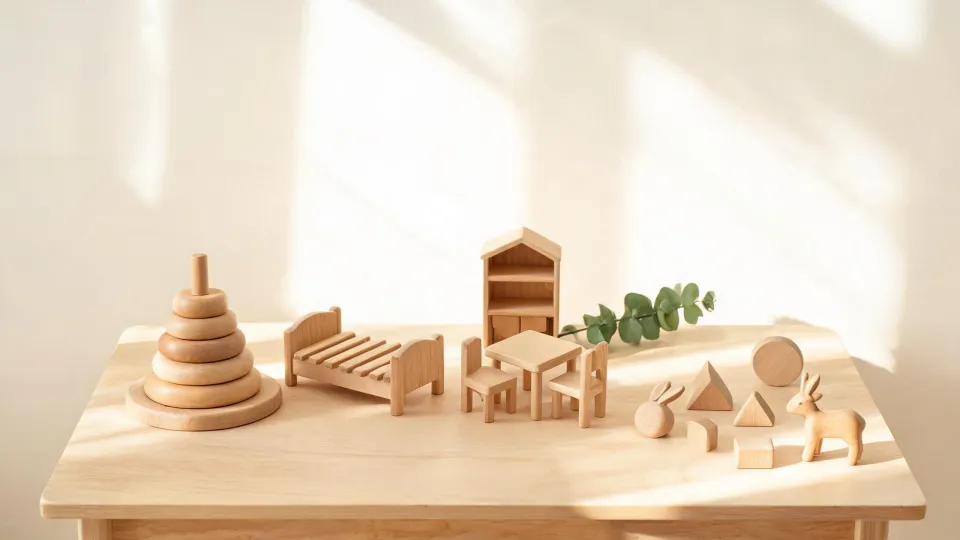
If you searched both names in one session, you are not comparing two versions of the same purchase. You are comparing two jobs a toy can do in your home, and the pick follows the job, not brand familiarity. The ComfyBumpy side of that search answers a present-tense need: a soft, immediately appealing purchase that solves something for a child or a parent today. The wooden side is a developmentally organized catalogue built by deciding child safety and age milestones before production, which is why the brand's own pages read like a curriculum rather than a wish list. That difference is the whole comparison. One side sells comfort and instant appeal; the other sells an object meant to stay in use across several stages. Ask which job has to get done this month, and the brand question answers itself.
Two names, two jobs: what this comparison is really asking
Start with what each side says it is promising, because the promises are not equivalent. The wooden side titles itself sustainable wooden toys for child development and sums up its pitch as "Play Safe, Play Smart," positioning itself as the non-toxic toy brand a parent turns to when the material question matters more than the novelty question. Read that as a category declaration, not a slogan: this side competes on what the object is made from, how it is produced, and which stage of development it targets. Its catalogue is organized so you can arrive with a developmental need and leave with a matching object. The comfort-led side of your search competes on a different axis: how quickly a purchase resolves a present problem, how soft or visually inviting it feels to a small child now, and how little friction it adds to a tired evening. Neither promise is fake; they answer different questions, which is why a single overall winner does not exist.
Which raises the question you probably came in with: if the two names answer different questions, why does searching them together feel so natural? Because both sides of the search use the same shelf vocabulary, safe and wooden and educational and age-appropriate, and that vocabulary collapses two very different offers into one shortlist. The wooden brand even borrows the word toy while running a catalogue indexed by developmental domain, and the comfort-led side borrows safe while selling relief. Your search engine does not separate those meanings, and neither does a product grid. The other reason the pairing feels natural is that both doubts live in the same parent at once: you want tonight to be easier, and you want the money you spend to still be doing something next year. Holding both doubts inside one comparison is reasonable; letting them produce one verdict is not.
Once you sort by job, three things in your buying process change. First, space stops being neutral. A comfort purchase can be small, soft and folded away; a construction-led set usually needs a surface, a basket and a place it can stay assembled, because a toy that has to be packed up after every session gets played with less. Ask whether your apartment has a footprint for a set that lives out, not just a shelf for something that goes away. Second, you stop treating the purchase as one decision and start treating it as a sequence: if the comfort need is acute this month, it gets the budget now, and the wooden set becomes the next purchase or the birthday request. Third, your time horizon changes what a price tag means. A cheaper object that exits use in a season costs more per month of use than a set that stays out for years, and that arithmetic is the one thing the shelf itself never shows you.
Why material and manufacturing decide what a toy can do
The causal chain starts before any shape is drawn. The brand's own account says it uses leftover sawdust to create a new material called PlanWood, and it groups its practice into three pillars it calls Sustainable Material, Sustainable Manufacturing and Sustainable Mind, the trio it also describes as a Sustainable Way covering materials, methods and mindset. That matters for a buyer because it converts an environmental claim into a production constraint you can reason about. If a factory treats its own waste stream as a raw input, the material set available to its designers is fixed early, before the blocks, ramps and gears get chosen. Sustainability here is not a badge added at the end of the process; it is part of what decides which shapes are affordable to make, how heavy they end up, and how consistently a run can be repeated. That is a different position from a brand that buys finished goods and picks a colourway.
Then come the design rules, and this is where the finished object diverges most from a comfort-led alternative. The brand states that it focuses on child safety and age milestones during design and production, with the aim that its wooden toys enhance both physical and cognitive development. Practically, that is a constraint chain: a milestone fixes what a child can safely mouth, grip, drop and take apart, and that fixes part counts, edge radii, the size of the smallest component, and how many stages a mechanism can have. A design team working under that rule cannot chase novelty first and test later, because the age target is an input rather than a label printed on the box. The lineage supports the same reading: the company traces back to 1981, when seven university graduates started with a shared mission, and one of its earliest products, a geometric sorting board, is still on sale today. Nearly four decades of the same object staying in range is evidence the constraint was set well enough that a stage-specific toy keeps working.
So does the sustainability story mean anything for your child, or is it a supply-chain claim dressed up as a benefit? Partly the second, and being honest about that is useful. A sawdust-derived material and a three-pillar manufacturing philosophy will not make a two-year-old reach for a toy more often; play value comes from the design constraint, not the waste stream. What the material story does change is durability and the terms of ownership: a solid, consistently produced wooden object survives drops, shared play and the hand-me-down trip to a cousin, and it does not need to be replaced when the first stage ends. It also settles a worry behind a lot of parent searches: whether the thing your child puts in their mouth was designed by people who thought about materials before margins. Green does not mean better-matched, though. The stage fit is still what decides whether the toy gets played with.
Where the design intent shows up in everyday play
The catalogue is where that abstract intent becomes a filter you can actually use. The shop is organized by developmental domains, with Mathematics & Literacy and Blocks & Construction and Learning & Education as the entry labels, and it is cross-cut by named collections such as Montessori-Inspired, alongside a seasonal Spring Favorites tier priced under $25. Read that structure as an instruction: pick the domain your child is currently working on, then the collection, then the price tier. That order matters because it runs opposite to how most toy shopping works. Domain-first shopping asks what the child is practising, whether that is sorting, stacking, early literacy or cause and effect, and only then looks for an object. Collection-first shopping asks which shelf label looks best. If you reverse the order and start from a price tier or a trending collection, you can still land on a good object, but you have given up the only filter the catalogue was built to provide.
Which named objects actually carry the design intent, and what does each one demand of your room? The High Contrast Series is pitched at helping little eyes start discovering the world, which places it at the earliest end: high contrast, low part count, a shelf item rather than a floor item. The PlanSpace Modular Dollhouse advertises stackable fun and endless creations, and its modularity is the point: it grows with the room, but needs a floor footprint and somewhere for the modules to live between builds. The Ramp Racer is described in review material as sturdy and elegantly designed, with visual contrast between the wooden track and the coloured cars making the speeding cars easy for children to follow, which also means it needs a run-out length, so measure the floor before you buy it. The Jumping Acrobat is described as a design reduced to essentials, which is the small-footprint answer for a child who wants to make something happen. The label on the shelf rarely says which one your room can hold.
The rule to use when you are standing at the shelf
Here is the version of the question you will actually face: a fixed budget, a small apartment, one child between toddler and preschool, so do you buy the comfort purchase first or the wooden set first? Use the catalogue's own tiers to bound the answer. There is a seasonal tier priced under $25, and because the catalogue is indexed by both domain and collection, you can make the developmental purchase without spending the whole budget on one object. The test to run before you spend is simple: which of the two purchases is still in the room in three years? If the honest answer for the comfort item is probably not, and it solves this month, that is a legitimate reason to buy it; just size the spend to the lifespan. If the wooden set is the one that outlives the stage, it deserves the larger share of the budget, and the under-$25 tier is where you prototype that decision instead of committing to it.
Now the part everyone leans on too hard: outside recognition. The available material carries an unusually long acknowledgement list, including Spiel Gut in Germany, the Red Dot Design Award, and the Oppenheim Toy Portfolio and Parents' Choice awards in the USA. All of it is real, and all of it settles less than a shopper hopes. An award confirms that a panel judged the object well designed, well made or unusually good for play at the moment they reviewed it; it does not confirm that the object matches your child's current domain, that it fits your floor, or that it will hold attention after the first week. Where the list earns its place is in breaking a genuine tie: if two wooden options both match the domain and the stage, and you cannot separate them on material or mechanism, take the one with the independent recognition. Where it fails is as a substitute for the stage question, or as a reason to buy a set your child has already outgrown.
The rule, then, in the order you apply it. Match the developmental domain first: name the skill your child is practising this season, and treat every collection label as a way to reach that domain, not as a ranking. Match the stage second, using the design constraint the brand applies during production as your sanity check, with fewer and larger components for the child who still mouths things, and more mechanism and more pieces for the child who already builds. Bound the spend third, using the price tiers rather than your willingness to pay, because the range is deliberately wide: full play sets sit next to small items and even a replacement part for a single piece. Use award recognition fourth, and only to break a tie. The order is the method, and skipping the first two steps is how a well-reviewed object ends up in a cupboard.
If you keep only one sentence from this comparison, keep this one: buy the job, not the brand. The comfort-led purchase is the right answer when the need is now, when the budget is tight, and when a soft, immediately appealing object is what will actually be used this week. The wooden set is the right answer when the need is a stage your child keeps working on, when the room can hold something that stays assembled, and when you want the money to still be earning its place next year. Those are different purchases, and a household with a small child can absorb both in the same year without either one being a mistake. What turns it into a mistake is buying the wooden set because the award list looked impressive, or buying the comfort item because it was the first thing the search returned. Sort by job first, and the rest of the decision gets short.

Jane Smith
I’m Jane Smith, a senior content writer with over 15 years of experience in the packaging and printing industry. I specialize in writing about the latest trends, technologies, and best practices in packaging design, sustainability, and printing techniques. My goal is to help businesses understand complex printing processes and design solutions that enhance both product packaging and brand visibility.