PlanToys Victorian Dollhouse: More Than a Static Model
Posted on 2026-08-14 by Jane Smith
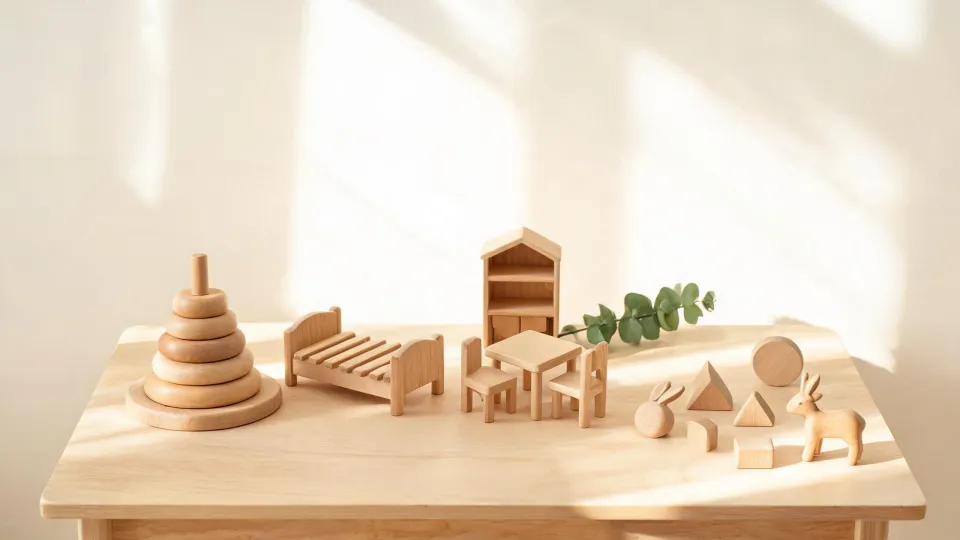
The first sound comes from the corner of the living room, a soft click of wood against wood as you set the PlanToys Grand Victorian Dollhouse down on the rug. Your four-year-old pauses mid-tap on her tablet and looks up, then pads over to run a finger along the little gabled roof. Before you can say a word, she's already murmuring a story about who lives in which room. In that quiet moment, you wonder if this is more than just a toy.
A New Laugh in the Living Room Corner
You had spent the morning comparing dollhouses. Plastic sets with plastic furniture, pink plastic everything, all promising instant play. But the PlanToys Grand Victorian Dollhouse was different. When you lifted the lid, the smell of warm wood filled the room - natural wood, not laminated particleboard. The little house had a proper staircase, a porch, and windows you could actually open. Tucked beside it in the catalog were other pieces from the same brand: a Victorian Bathroom Set, a Tropical Fruit Basket, even a Farmers Market Mix Basket. They were all part of one open-ended world, and the catalog made that clear without a single word about how to play. What mattered, though, was the way your daughter, who had barely glanced at the cardboard box, now knelt and peered through the front door as if it were a real home. She didn't ask what it was. She asked, 'Where do the people sleep?' She was already moving in, unpacking an imaginary future.
At first you thought the whole thing was just a pretty sculpture. A dollhouse that's meant to be looked at, not touched. But as your daughter moved her fingers from the roof to the front door, you noticed that every part of the house opened, swung, or slid. The windows actually opened. The little front door had a working latch. This wasn't a display piece; it was a stage. And the more you watched, the more you began to doubt your old assumption. The PlanToys website had a phrase that kept circling in your head: 'Sustainable Wooden Toys for Child Development.' Not just 'toys for kids,' but toys designed around how children actually grow. That phrase nudged at something. Maybe this dollhouse was designed for more than decoration. Maybe the brand really did think about the child on the other side of the toy. It was beginning to feel less like furniture and more like a decision.
It's Not a Static Model for the Shelf
Here is the most common thing people say about wooden dollhouses: they are static. They sit on a shelf, pretty and inert, and children lose interest after a week. And there's a second, more loaded assumption: that a dollhouse like this is 'for girls,' a training ground for domestic stereotypes. Neither of those things held true in your living room. The first afternoon, your daughter didn't arrange the furniture once and walk away. She rearranged it, then took the little staircase out, then put it back, then told you that the family was going on vacation and needed the fruit basket for a picnic. The toaster went into the bathtub. The dog went to sleep in the refrigerator. None of it made logical sense, but all of it made story sense. The toy was not static. It was a world waiting to be parsed.
Why does that matter? Because the act of moving a tiny chair from the bedroom to the living room is not just a motor exercise. It's a narrative decision. She has a plan: the family will wake up, they will eat breakfast in the living room while it's still sunny, and then they'll all go to the bathroom to brush teeth. That's sequencing, cause and effect, and a vocabulary of rooms and actions. PlanToys explicitly says that its toys are designed with child development in mind, focusing on child safety and age milestones to enhance both physical and cognitive development. So when your daughter picks up the two little wooden people and makes them argue over who gets the top bunk, she's not playing 'house'—she's building a miniature society. That's the kind of play that researchers link to language growth, empathy, and problem-solving. That is the hidden curriculum inside the wooden walls, and it only grows richer the longer the toy stays out. Watch her long enough, and you'll see it take hold.
The company states it plainly: 'At PlanToys, sustainability and child development are our top priorities.' That's not marketing fluff found in a press release; it's the filter through which every product is evaluated. When they say they design for age milestones, they mean the dollhouse's proportions are scaled to small hands, the windows are large enough for a child to see inside, and the edges are smooth enough for a toddler's grip. This is a company that has thought about what happens when a four-year-old tries to put a wooden person into a wooden bed for the hundredth time. The design doesn't fight her; it meets her at her level. That's why the dollhouse doesn't end up in a donation pile. It stays because it was built to serve a child's development, not just a grown-up's idea of a nursery. That's a standard worth paying for.
From One Tree to a Dollhouse
To understand why a dollhouse can cost more than a plastic playset, you have to go back to 1981. That year, seven university graduates came together in Thailand with a shared mission: to infuse the world with positivity. Vitool Viraponsavan, the strongest voice in that group, went on to found PlanToys. Four decades later, the company has spread to Asia, America, Europe, and Australia, but the founding impulse remains. They call it the 'Sustainable Way'—a fusion of sustainable materials, manufacturing methods, and mindset. When you hold this dollhouse, you're holding a product of that long thread. It's not a corporate pivot or a greenwashing afterthought; it's the logical output of a company that began with ideals and has spent forty years refining them. That history matters when you're deciding whether to spend money on a wooden toy. You're not just buying a happy afternoon; you're buying a piece of that journey. And that gives the purchase a weight a plastic set simply cannot carry.
The manufacturing story is where the sustainability gets concrete. Rubberwood is the main material, but the even more interesting part is what PlanToys calls PlanWood. PlanWood is made from the leftover sawdust that would otherwise be wasted. Instead of throwing it away, the company compresses it into a new material that's stable, strong, and smooth. In practical terms, that means the dollhouse you're looking at might contain recycled wood fibers in its more intricate pieces—the little spindles on the porch, the tiny moldings. This isn't just an environmental gesture; it also gives the toy a consistent texture and makes it less likely to splinter. The same sawdust that a less careful factory would burn is being turned into the detail that your daughter fingers while she thinks about her next move. That's the kind of care that shows up in the final product. That's a detail you'd never see in a catalog, but you'd feel it the first time she picks it up.
What does that mean for you? It means the dollhouse is safe in the most literal sense. PlanToys says it focuses on child safety during production, and the use of natural rubberwood and PlanWood means you're not worrying about the off-gassing that can come from some plastics or finishes. The wood has a warm, natural grain, and the pieces fit together with a satisfying click. Durability is another benefit: this isn't a toy that will crack in a year. Wooden toys, when well-made, can survive a childhood and then live on as hand-me-downs. That converts the price from a one-time expense into a long-term investment. Suddenly the 'expensive' dollhouse starts to look like the cheaper option over the course of several years of play. And that math makes sense to anyone who has ever bought a plastic toy twice.
When She Puts the Little People in the Victorian Parlor
Once the dollhouse is in play, something interesting happens. Because the pieces aren't glued into a fixed scene, your daughter becomes a director. She might decide that the family needs to wake up early, so she moves them to the bedroom, then sits them at the kitchen table, then walks them out the front door. Each decision sets up a new problem, and each problem requires a solution. That kind of planning is a higher-order thinking skill, and it's exactly what open-ended toys are designed to provoke. PlanToys knows this—their website even categorizes products by developmental domains and features a Montessori-Inspired Collection. The dollhouse isn't just a house; it's a prompt for the child to ask, 'What happens next?' And because there are no prescribed answers, the story never runs out. You watch your daughter test a hundred tiny hypotheses before dinner. Each one is a small experiment in cause and effect, logical consequences, and social rules that she's mastering one play session at a time. It's learning disguised as play.
The world expands when you let it. The Grand Victorian Dollhouse belongs to a larger family of PlanToys miniature environments. There's a Victorian Bathroom Set—a little claw-foot tub and a tiny mirror—and a Tropical Fruit Basket, and even a Farmers Market Mix Basket. Place these next to the main house and suddenly your child has not just a home but a neighborhood. The bathroom becomes a place for the family to 'wash up' before dinner; the fruit basket becomes the groceries they carry in from the market. Each addition multiplies the possible stories. The website presents them all under one roof, so you can grow the play over birthdays and holidays, adding a room when the old one starts to feel crowded. That modularity is what turns a single toy into a lasting play system. It's the same principle as a well-stocked play kitchen: more pieces, more roles, more language to negotiate them. And the dollhouse is the hinge that holds it all together.
There's a reason PlanToys aligns itself with Montessori. Montessori education values self-directed activity, hands-on learning, and play that mirrors real life. A dollhouse is a perfect vehicle for that philosophy: it lets a child practice daily routines, negotiate social roles, and make choices without adult correction. When you set up a low shelf with the dollhouse and a few accessories within reach, you're creating a Montessori-style prepared environment—everything is accessible, orderly, and inviting. The child can choose her own scenario, work at her own pace, and repeat the same sequence until she masters it. That repetition isn't boredom; it's mastery. It's the same reason a Montessori classroom has polished wooden materials instead of flashing plastic ones. Wood invites concentration, and concentration is where learning happens. The Victorian dollhouse, with its quiet wooden presence, is exactly that kind of invitation. It's a silence that speaks volumes to a child's developing brain.
The Best Measure: When She Comes Back to Play
So how do you know if this is the right toy for your child and not just a pleasant status symbol? Use the re-visit test. Watch whether she returns to the dollhouse on her own, day after day, picking up a new thread of the story each time. A worthwhile dollhouse earns those re-visits; a mere sculpture doesn't. The dollhouse, with its working doors and movable furniture, is built specifically to encourage that return. It's also earned external validation: among its honors are the Red Dot Design Award and Japan's Good Toy Award, both of which look at design and playability, not just aesthetics. Those awards don't tell you whether your daughter will love it, but they tell you that the toy meets a high standard of thought. When a child keeps coming back, the toy is doing its job. That's the moment when the cost per play falls below any plastic alternative you were considering. It's a test that takes only one week to run.
By the end of the afternoon, the living room has become a miniature city. The Victorian dollhouse stands in the center, but the 'family' has migrated—two wooden people are sitting in the vegetable basket, and the tiny dog has been put to bed in a shoebox because, in your daughter's words, 'the dog got tired.' A third person lies on the roof, sunbathing, because 'the house is too warm.' She moves between the rooms, muttering new lines, adjusting furniture, knocking on the front door with her knuckle before stepping in. She doesn't once reach for her tablet. She's too busy narrating a plot that only she fully understands. This is the moment you were waiting for, the one that the catalog photos couldn't promise. She's not just playing house; she's running a world. The tablet lies forgotten on the couch, its screen dark, and no one has asked about cartoons in hours. That's the real verdict.
A few practical notes, if you're considering the same purchase. Intended for ages three and up, the dollhouse has small pieces that a determined toddler might try to mouth, so keep it out of reach until that stage passes. The main structure may require some light assembly—sliding dowels into pre-drilled holes—so set aside a few minutes with a friend or a cup of coffee. Once it's up, place it on a low table or a shelf your child can reach without climbing. Pair it with a small tray of accessories so everything has a designated home. That's the Montessori trick: order on the shelf gives the child a clear starting point, and the open-ended play does the rest. If your child is already three or four, expect to see the dollhouse used daily, but don't be surprised if the actual 'house' becomes just one stop in a much larger world.
That first click of wood against wood, the one that drew her away from the tablet, has become a familiar rhythm in your living room. What you thought was a static dollhouse turned out to be a portal, and she's still walking through it.

Jane Smith
I’m Jane Smith, a senior content writer with over 15 years of experience in the packaging and printing industry. I specialize in writing about the latest trends, technologies, and best practices in packaging design, sustainability, and printing techniques. My goal is to help businesses understand complex printing processes and design solutions that enhance both product packaging and brand visibility.